
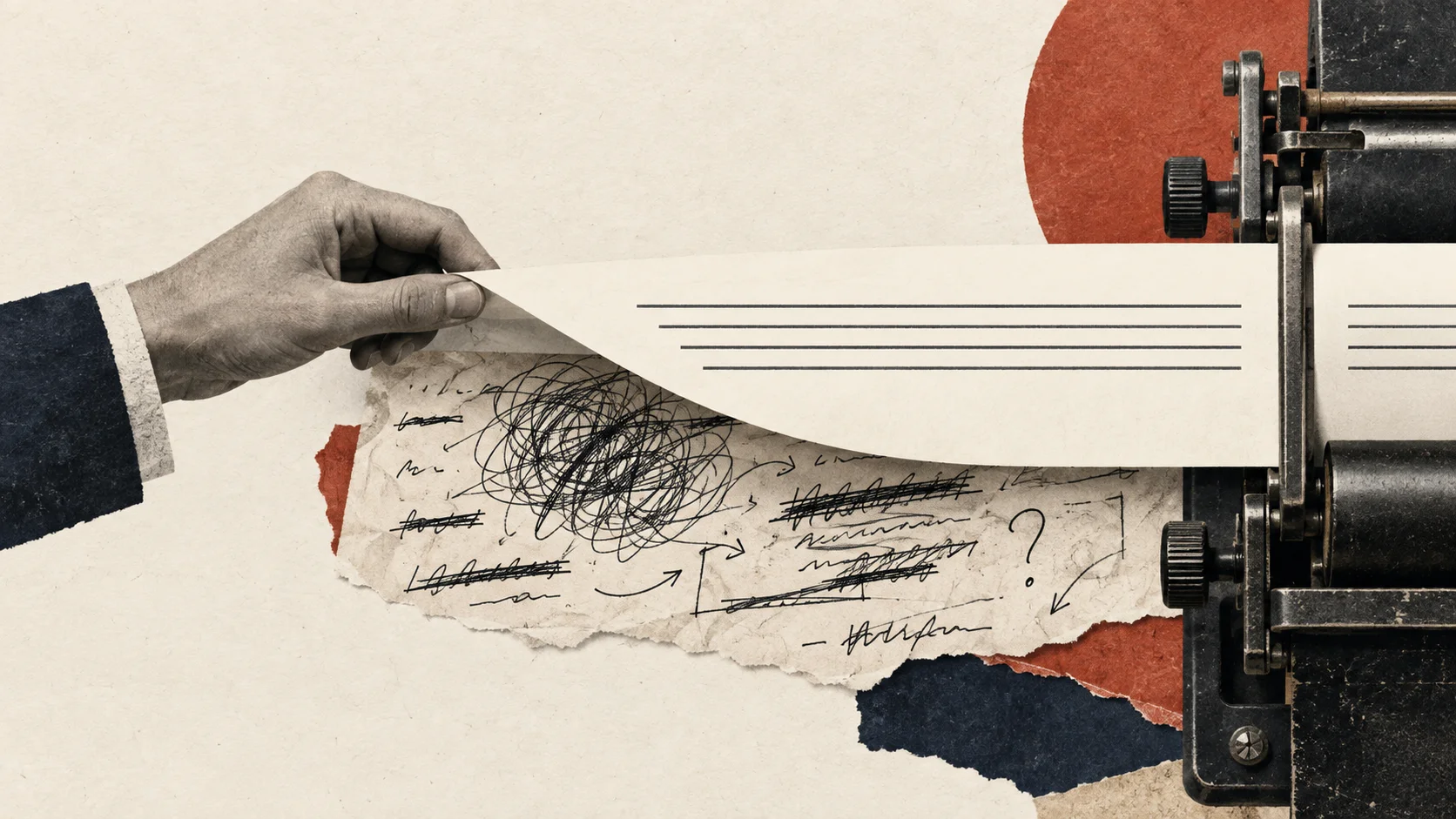
I use AI.
It helps me collect material and work on a draft. I can use it to test an idea. It can also produce a page of clean English at great speed.
That is useful.
It is also where the trouble starts, at least for me.
Smooth does not mean clear
AI likes a sentence that flows. It likes a balanced contrast. Give it half a chance and several points will appear in a tidy group of three.
Then comes “not only this, but also that”.
Again.
The grammar is sound, the tone is calm and the passage looks finished.
I may still have no idea what it means, though. I often don’t, even though the draft and idea are mine.
“This approach supports better alignment and drives meaningful outcomes.”
What approach? Who must align with whom? What will change? Oh no! Now I start writing in groups of three!
That sentence asks for no answer. It simply passes through the paragraph wearing clean shoes. I am sure my academic writing professor would have loved it.
Orwell saw the danger before AI
In his essay Politics and the English Language, Orwell wrote about ready-made phrases taking over the writer’s work. That was 80 years ago!!!
The phrase can save the writer from choosing words as in Orwell’s Newspeak. It can begin to shape the thought as well, to the better or worse.
AI did not create this habit, but it made the supply almost endless. So now I am supposed to get high on my own AI supply?
When I ask AI for a professional article, it has learned what professional articles usually sound like. That includes all the bad habits. Smooth links appear and abstract nouns gather. Nobody performs a visible act, even when the points arrive in neat groups of three.
If I accept such a draft because it sounds professional, I may be accepting borrowed thought. Most likely, that is exactly what I am doing.
I still have to know what I mean
AI cannot decide which part of my experience matters. Well, it does not have my experience for sure. It cannot know whether a statement is true because I have seen it or it merely sounds true because similar statements exist.
I have to provide the judgement.
What am I claiming? What facts do I have? Where am I guessing? Would I say this to a client across a table or to my partner over breakfast? You see what I just did there? Group of FOUR.
If I cannot answer that, any better wording will not rescue that idea.
This is why I now ask AI to leave some rough edges. My own voice is not a perfectly level road. In fact, it is rather bumpy as English is not my native tongue. I change pace and may use “I” more often than a writing guide recommends. Sometimes I repeat myself, but its just me being me, a mere mortal.
That is fine as I am the person making that claim.
Editing AI means removing its habits
I look for sentences with no actor. I cut introductions that merely announce what the next paragraph will say. I replace large words when the short word carries the same meaning.
Then I look for the polished sentence that nobody would actually use in real life. At least not me while entirely sober.
Some lines need deleting and others simply need a fact.
Sometimes I make the sentence less smooth because the smooth version sounds like everybody and therefore nobody.
I routinely feed my edited texts back to it just for it to learn more of how I deal with things. The aim is not to make AI write badly. The aim is to stop it writing instead of me. Me.
AI can still be useful
I can ask it to challenge an argument. It may show where a reader could misunderstand me. After I know what the draft must say, AI can help me cut it. Rather often, AI actually finds new angles and my blind spots, and man, do I have some.
I should still check every claim. I should also decide whether the final words sound like mine.
Using AI is not the same as handing over authorship. So, if you now say, “This is AI slop”, you can go and read something else.
The tool can help me write, just like a quill or a typewriter, or can fix my gramma like Grammarly or QuillBot, although it can do a bit more. But it cannot take responsibility for what I publish. Ever.
A simple final check
Before I accept an AI-written sentence, I ask whether I understand it in plain words.
If I do, I can usually rewrite it.
If I do not, the sentence has no business pretending to explain the matter to somebody else.
Orwell’s essay was written long before a machine could produce fluent text. Yet it may be more useful and relevant now than it was then. People now have actual experience of machine-made fluent text.
The supply of words has become cheap.
The thinking has not.
George Orwell, Politics and the English Language: https://www.orwellfoundation.com/the-orwell-foundation/orwell/essays-and-other-works/politics-and-the-english-language/
If you want to discuss how AI could support your work without taking over your judgement, have a look at www.baleteworks.com or send me a message here on LinkedIn.